Everyone talks about AI in language, art and even a conceptual space, but we can generate and model service space for humans using a more conservative parametric design approach.

Generative design is a framework for combining digital computation and human creativity to achieve results that would not otherwise be possible. It involves integrating a rule-based geometric system, a series of measurable goals, and a system for automatically generating, evaluating, and evolving many design options.
Autodesk University and datajungleadventures.com
While this is a standard in architecture, product and package design, humans still plan and design physical environments. Modelling and simulation to detect patterns and processes in environmental data is common practice in environmental science and ecology research.
But can we combine interactive, parametric design with randomness to generate open spaces, natural or not? How about urban planning altogether?
Urban design problems generally presents many stakeholders, often representing conflicting requirements and interests, thus intensifying the complexity of the design. Generative design can aid the management and structuring of such complexity by defining the objectives and constraints. In this case, projects involve diff1erent goals:
- financial (revenue and cost)
- environmental (e.g. solar gain and views)
- architectural ones (such as variety)
Machine-driven design raises some questions:

- Workplace redundancy: will human make them self-redundant by designing technology with human like capacity?
- IP or ownership of non-human made designs (applies for creative art and literature as well): who owns AI-generated work?
- How to translate human and emotional design approaches and questions into constraints and parameters to drive the designed experience of physical spaces?
- How far can we go with generatively designing urban context and landscapes?
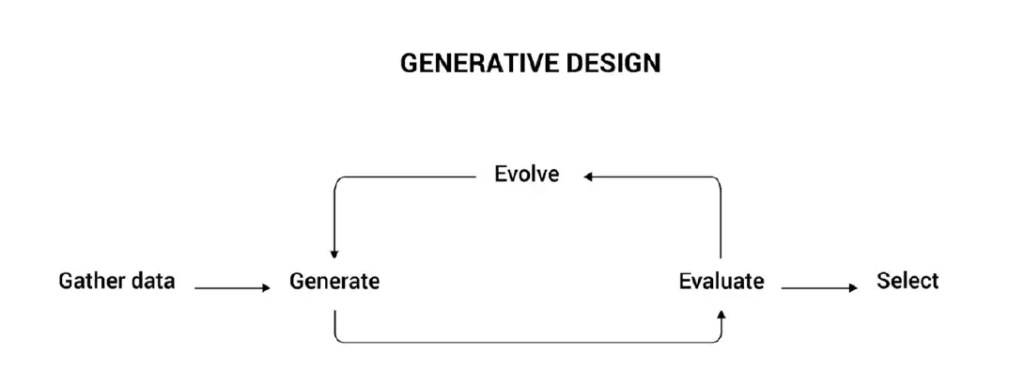
Opportunities and strength
The main strengths of generative design encompass its ability to simultaneously comprehend the larger context of the environment while still pursuing detailed parameters such as specific aspects of microclimate or soil ecology. Generative planners can explore hypotheses and design options in a relatively short time span, testing numerous alternatives quickly,
- Hundreds of design suggestions that you can instantly experience in VR.
- Data-driven design solutions, for example, the microclimate of parks suitable for the local residence
- Reverse engineer designs: set budget as a constrain and see what can be developed.
- Ecosystem service-driven approach: what cooling or biodiversity do you want to obtain
- Multi-dimension>3d approach to include time. growth, deterioration and usage
Where does machine-driven design sit in the planning framework and site-based design process?
Before the design, during it, and after the creation of the design, the machine has a say at different stages:
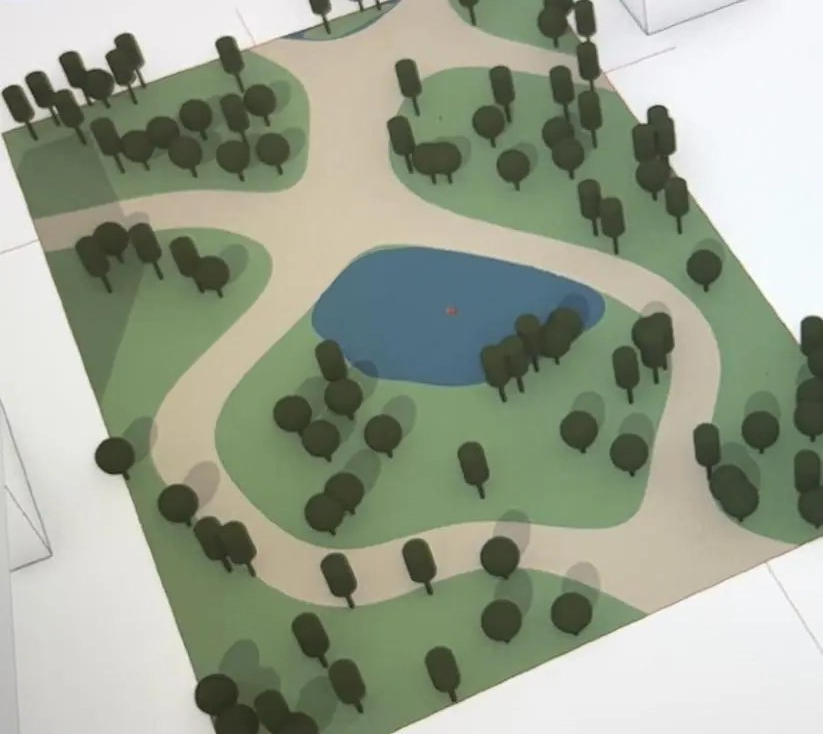
Efficient space allocation using generative design tools.
- To define design requirements (basically talk to client, survey user expectations, …)
- For data collection and site analysis
- Pre-concept stage:
This is where parametric design helps to refine design requirements and propose a framework for human design. - Concept stage:
Generative design can propose conceptual plans based on constraints such as budget, space allocations, physical constraints on site, planning regulation, or services that a space has to provide (heat sink, shade area, erosion, or biodiversity. - Schematic design stage:
Adding more detailed and constrained detailed space allocation plans can be proposed by complex models. - Detail design stage:
Requires a lot of data to design complex open spaces to a level that allows them to construct. - Construction stage
Generative design can be a part of the overall planning framework and site-based design process, by helping to identify, analyze, and develop strategies for open spaces and landscapes. The process identifies potential problems and solutions before generating a design. This way it allows the creation of a design tailored to the context and user needs.
Generative design can also help support the decision-making process by allowing the designers to develop and test numerous options in a relatively short timeframe.
To understand how GD tools works in landscape architecture, we created a project with two main aims:
- Explore the process, the requirements, and the method to approach such a project.
- Create proof that this project can generate realistic design options, use different design scenarios, and help mitigate design, construction, and monitoring problems
Subscribe to follow our generative design adventure!

 data jungle adventures
Leave a comment