Being eligible to conduct Environmental Impact Assessments (EIAs) in Saudi Arabia is a key requirement for environmental consultants seeking to support development projects across the kingdom.
The Saudi Arabian Permitting Support Tool is a streamlined guide designed to help project developers, consultants, and stakeholders determine the environmental permitting requirements for industrial and development projects in the Kingdom of Saudi Arabia (KSA). It is particularly useful for navigating the requirements of the Permit Application Package (PAP)—a mandatory component of the project planning and approval process.
Certain consultants have extensive experience preparing PAPs, which typically include EIA studies in line with the Royal Commission Environmental Regulations (RCER2015). Established in the 1970s, the Royal Commission (RC) plays a central role in the environmental oversight of industrial cities like Jubail, Yanbu, and the more recently developed Ras Al Khair. The RC was mandated to ensure world-class industrial development while upholding high environmental standards.
what is NCEC?
Established in 2020 as an independent financial and administrative entity, the National Center for Environmental Compliance (NCEC) plays a pivotal role in safeguarding Saudi Arabia’s environment and ensuring sustainable development. Created as part of the Kingdom’s commitment to environmental protection and balance, the NCEC operates in close coordination with other components of the national environmental framework.
The Center is tasked with monitoring the environmental compliance of all development activities across the country. It sets and enforces environmental regulations, standards, and conditions to ensure that projects align with Saudi Arabia’s approved environmental frameworks. In doing so, the NCEC supports the Kingdom’s vision of balancing development with the preservation of natural resources and ecological integrity. The Center’s vision is to lead in environmental compliance, support the sustainability of ecosystems, contribute to the growth of development sectors, and enhance quality of life. While its mission is to work with all stakeholders to elevate environmental compliance by monitoring pollution, conducting environmental assessments, and strengthening environmental oversight and guidance.
Through its proactive role, the NCEC is not just a regulatory body—it is a cornerstone of Saudi Arabia’s environmental governance, contributing to long-term sustainability and the success of Vision 2030, and offering a portal that guides applicants through the permit process.
Understanding the Environmental Permitting Pathway
The permitting pathway in Saudi Arabia depends first on the jurisdiction of the project:
- If the project is located within Jubail, Yanbu, Jazan, or Ras Al Khair, it falls under the Royal Commission (RC).
- Projects in other areas of the Kingdom are assessed by the NCEC.

If the project is under the NCEC, you must determine whether it has already been classified. Once classified, or if classification is still anticipated, the environmental category dictates the required documentation:
- Category 1: Minimal environmental impact (confined within project boundaries). This requires an Environmental Management Plan (EMP).
- Category 2: Moderate impact at different project stages. This requires an Environmental Impact Assessment (EIA) Report.
- Category 3: Significant environmental impact likely to exceed project boundaries. It requires both an Environmental Impact Assessment Study Scope Report (ESSR) and a full EIA Report.
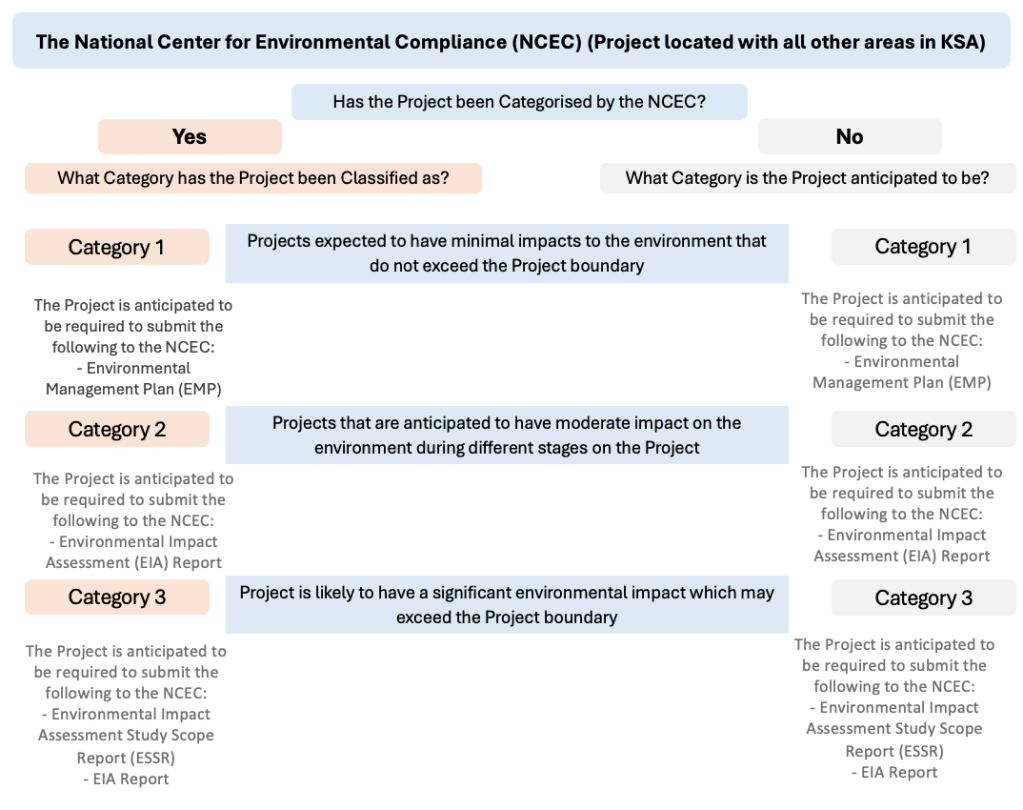
This classification ensures that projects are reviewed appropriately, reflecting their scale and potential environmental consequences.
Whether your project is in an RC-governed zone or under NCEC, the right consultants can guide you through the full permitting process—from the Environmental Scoping Report to Best Available Techniques (BAT) Assessments, Air Dispersion Modeling, and Noise Impact Studies—ensuring timely and robust submissions.
Featured image by Grant Ritchie on Unsplash
 data jungle adventures
Leave a comment