The personification of urban spaces seems to be a current trend. Today, we read about cities that are smart, resilient, inclusive, creative, and even learning. In today’s rapidly urbanising world, the concept of smart cities has emerged as a beacon of hope for addressing the challenges of modern urban life. But what truly powers these cities of the future? The answer lies in data—the lifeblood of every smart city initiative. What role does data play in smart cities, and where are these cities?
Data, the backbone of urban innovation
At its core, a smart city leverages technology to enhance quality of life, improve efficiency, and promote sustainability. However, technology alone cannot achieve these goals. The real work happens when cities integrate vast amounts of data from various sources—such as sensors, cameras, and user devices—and use it to make informed decisions.
For example:
- In traffic management, data from GPS devices, traffic sensors, and ride-sharing apps optimises traffic flow and reduces congestion.
- Smart grids analyse energy usage to minimise waste and balance supply and demand.
- Surveillance systems combined with AI-powered analytics predict and prevent crimes in public spaces.
Data integration—combining information from multiple sources into a unified system—is essential for smart city functionality. Without integration, data remains siloed, limiting its potential. Smart cities employ platforms that aggregate and analyse this data to provide a comprehensive view of urban dynamics.
Smart City Index
Published by the World Competitiveness Center in partnership with WeGO, the Smart City Index (SCI) today provides a time series across five years to compare specific cities’ performance throughout time.
The 2024 report evaluates the perceptions of urban residents regarding their cities’ infrastructure and technological solutions while ranking 142 cities worldwide. The SCI team communicates two – out of several – interesting messages.
- The global landscape of smart cities continues to change, but the changes are more spectacular among middle-ranking cities than among the top performers.
- Globally, as the world continues to change rapidly amid increased uncertainties, cities are places where new solutions and ways to be future-ready are emerging. In such a world, digital inequalities take on a new meaning.
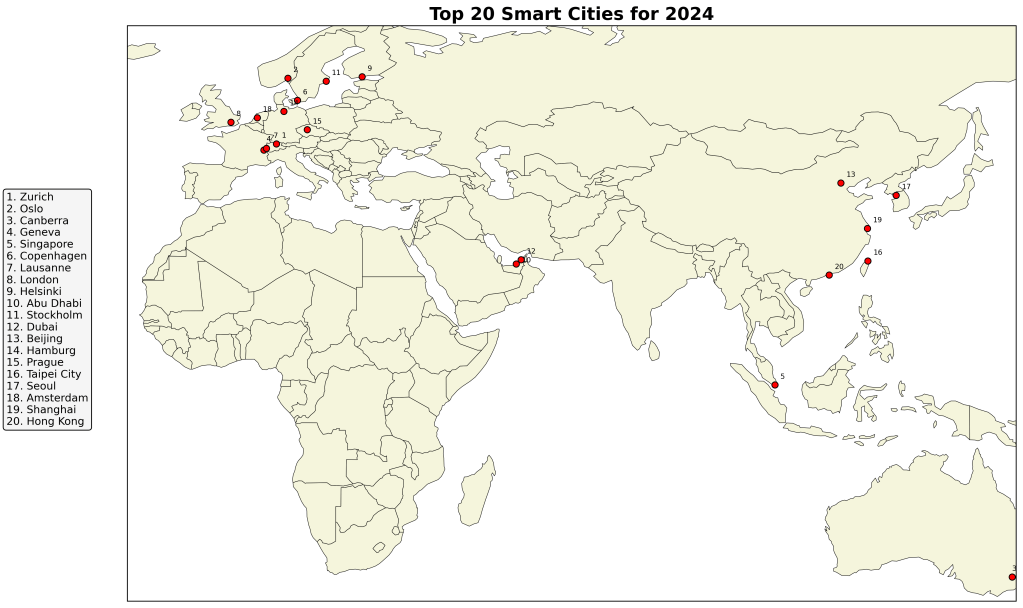
The top 20 cities remain unchanged from 2023; cities like Zurich, Oslo, and Singapore dominate the list due to their advanced technological infrastructure and governance models. Only a few top-ranked cities are in the Global South (Singapore, Abu Dhabi, Dubai), prompting questions about whether economic disparities or other factors contribute to this underrepresentation.
Other cities have shifted rankings between 2023 and 2024. For instance:
- Riyadh climbed from 30th place in 2023 to 25th in 2024.
- Doha rose from 59th place in 2023 to 48th in 2024.
While financial constraints can limit technological development in some regions, it would be overly simplistic to attribute this solely to economic factors. Many Global South cities are making strides toward becoming smart cities by leveraging innovative solutions tailored to their unique challenges—for example, GIFT City in India is an emerging smart city with advanced infrastructure and services.
An interesting study critically reviewed current smart cities indexes, identifying six major ones in 2022.
- The IMD-SUTD Smart City Index
- AT Kearney Global Cities Index
- IESE Cities in Motion Ranking (CIMI)
- Cities of the Future Index (CFI) by Easy Park Inc.
- Mori-Foundation Global Power City Index (GPCI)
- SECI Index by Smart EcoCity Ltd.
No single index, though, is considered superior, highlighting the need for a globally agreed-upon methodology for evaluating smart cities to avoid confusion.
Final words
Beyond the “smart city” concept, terms like “sustainable cities,” “eco-smart cities,” or “inclusive cities” highlight diverse approaches to urban development. Amid these terms, it’s vital not to lose sight of prioritising both human well-being and environmental sustainability in all space descriptions.
Feature image by Joshua Golde from unsplash
 data jungle adventures
Leave a comment