The Global Biodiversity Information Facility (GBIF) is an international open data infrastructure that provides worldwide access to biodiversity data. Publishing data to GBIF involves several steps and key participants, including data publishers, partner institutions, and the technical infrastructure that supports data sharing.
TLDR: Biodiversity data is essential for management and policy and is published globally by GBIF. Public data gaps exist in some taxa, particularly in Asia, Africa and the Middle East. KSA is also data deficient despite recent contributions. Sharing your biodiversity data can help fill critical knowledge gaps, especially in underrepresented regions. Leave a comment!
GBIF data offers numerous benefits by providing open access to global biodiversity information, supporting diverse applications used by researchers, policymakers, conservationists, educators, and the public. Researchers utilize GBIF data to study species distribution and ecological relationships, while conservationists identify critical habitats and develop species protection plans. Policymakers leverage the data to create informed environmental policies and sustainable development initiatives. Educators use it to enhance curricula and promote public awareness, and citizen scientists engage in data collection and biodiversity research. Overall, GBIF facilitates global collaboration, data sharing, and a deeper understanding of biodiversity, aiding in effective conservation and sustainable development efforts.
Data Publishing
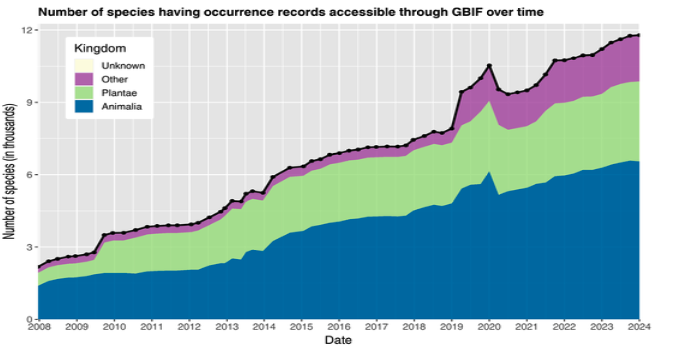
Number of species with occurrence records accessible on GBIF
Data publishers are institutions or individuals that collect and share biodiversity data. They include research institutions, museums, universities, government agencies, and NGOs and contribute data sets, including species occurrences, checklists, and ecological surveys. Partner institutions support GBIF’s mission through funding, data sharing, and collaboration. They include national biodiversity information facilities, research organisations, and international agencies such as the European Union, national governments and organisations like the Natural History Museum in London.
Data Collection and Preparation
GBIF’s infrastructure relies on a collaborative network of participants who contribute to its mission of providing open access to biodiversity data.
Researchers and Institutions: Data is initially collected by researchers, citizen scientists, museums, botanical gardens, and other institutions. This data includes species observations, specimen collections, and ecological survey results.
Data Formatting: Before submission, the data must be formatted according to GBIF standards. This typically involves using Darwin Core (DwC), a standard for biodiversity data that facilitates data sharing and integration.
Metadata Creation: Publishers must create metadata describing their datasets. This metadata helps users understand the content, context, and quality of the data.
Data Submission
Integrated Publishing Toolkit (IPT): GBIF provides the Integrated Publishing Toolkit (IPT), a free, open-source software tool that helps data publishers share their biodiversity data. The IPT supports managing, transforming, and publishing data and metadata. Once the data is uploaded and validated through the IPT, it can be published to GBIF. The data becomes accessible through the GBIF portal, where users can search and download it. GBIF performs additional quality control checks to ensure data accuracy and consistency. This includes checking for geospatial errors, taxonomic issues, and other potential problems.
Data Accessibility: Published data is freely accessible to anyone worldwide, supporting research, policy-making, and conservation efforts. GBIF’s data portal (www.gbif.org) allows users to search, access, and download biodiversity data. The portal provides tools for data visualisation, analysis, and integration with other databases. GBIF offers APIs and other services that allow developers and researchers to integrate GBIF data into their applications and workflows.
Biodiversity Data in Underrepresented Regions
Certain regions, particularly the Middle East, Africa, and parts of Asia, are underrepresented in the GBIF database. This disparity highlights the need for more biodiversity data from these areas to comprehensively understand global biodiversity.
Middle East: The region hosts unique ecosystems and species underdocumented in global biodiversity databases. Increasing data from the Middle East can aid in conservation efforts and sustainable development.
Africa and Asia: Similar gaps exist in Africa and parts of Asia. Enhanced data collection in these regions can support biodiversity conservation, climate change mitigation, and sustainable resource management.
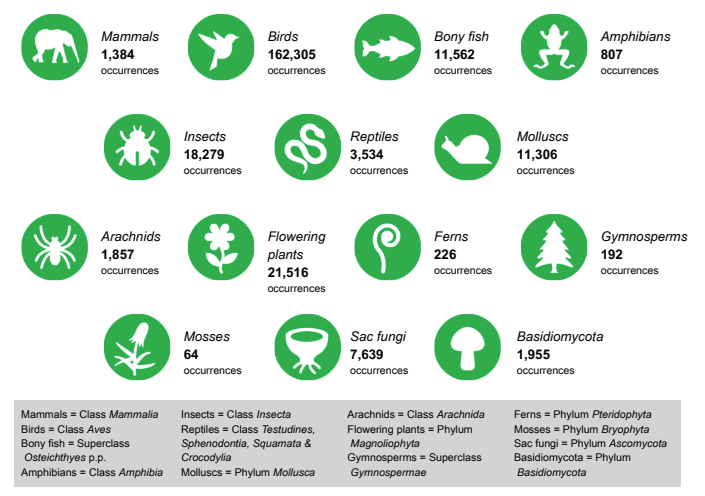
Total data available for selected taxonomic groups in Saudi Arabia
Public Biodiversity Data for Saudi Arabia is sparse in our article “Is KSA’s biodiversity data representative?“. As the 10th largest country in the world, it is host to a varied biodiversity stemming from its pivotal location between Africa and Eurasia, which allows elements of both regions to intermingle. There are 2,250 species of flowering plants in Saudi Arabia of which some 246 species are considered regionally endemic. About 450 species (18%) of flowering plants have direct benefits to human beings and 45 species (1.8%) are poisonous. Some 334 species (13.4%) are used in folk medicine or are known to have medicinal value. There are 93 mammal species, 432 bird species, 9 freshwater fish species, 103 reptiles and 7 amphibians found in Saudi Arabia. More at https://www.cbd.int/countries/profile?country=sa.
Recent publications
With the recently uncovered plant data set (Thomas et al. 2016) and plantdiversityofsaudiarabia.info, we observe a novel stream of information (350k records, 3x the currently available data) for this unique environment. A hosted IPT instance operated by bödeker, a local architecture and planning firm, provides an onramp for all dormant biodiversity data sets.
Join the global effort to document and protect our planet’s incredible biodiversity by submitting your data to the Global Biodiversity Information Facility (GBIF). Whether you’re a researcher, a conservationist, a citizen scientist, or part of an institution, your contributions are vital. By sharing your biodiversity data, you can help fill critical knowledge gaps, especially in underrepresented regions like the Middle East, Africa, and parts of Asia.
Publishing data to GBIF involves a structured process that ensures data quality and accessibility. By becoming a data publisher, institutions contribute to a global effort to document and conserve biodiversity. Addressing data gaps in underrepresented regions like the Middle East, Africa, and parts of Asia is crucial for a complete understanding of global biodiversity patterns. Through collaboration with partner institutions and the use of robust technical infrastructure, GBIF continues to facilitate open access to biodiversity data, supporting research and conservation worldwide.
By understanding and participating in this process, researchers and institutions can help enrich the global repository of biodiversity data, driving forward the goals of conservation and sustainable development.
 data jungle adventures
Leave a comment