Will financial technology linked to environmental goals rescue Planet Earth?
What are carbon credits and their markets?
Selling and buying carbon credits form the essence of trading systems in carbon markets. The traders are people or companies. The traded goods are carbon credits and greenhouse gas emissions. Pretty simple till here.
So, through specialised finanacial markets, carbon credits are sold and bought.
As mentioned by the UNDP, companies and individuals can use carbon markets to compensate for their greenhouse gas emissions by purchasing carbon credits from entities that remove or reduce greenhouse gas emissions.
One tradable carbon credit = one ton of Carbon Dioxide
UNDP

One tradable carbon credit equals one ton of carbon dioxide (CO2). This formula extends to include any other greenhouse gas. Meaning, if 1 tradable carbon credit is equal 1 ton of carbon dioxide, it can also be equal to the equivalent amount of Methane (CH4), Nitrious oxide (N2O), Fluorinated gases.
The importance of carbon markets lies in the ability to finance and lead the transformation required to reduce greenhouse gases emissions.
In parallel, it may also be useful to mention that some references consider “carbon credits” and “carbon offsets” to be used interchangeably. Yet, carboncredits.com explains the difference:
- Carbon credit is an allowance for a company holding the credit to emit carbon emissions or greenhouse gases.
- Carbon offset is a way to balance out the carbon emissions a certain side produces by investing in projects that reduce emissions elsewhere.
Types of carbon markets
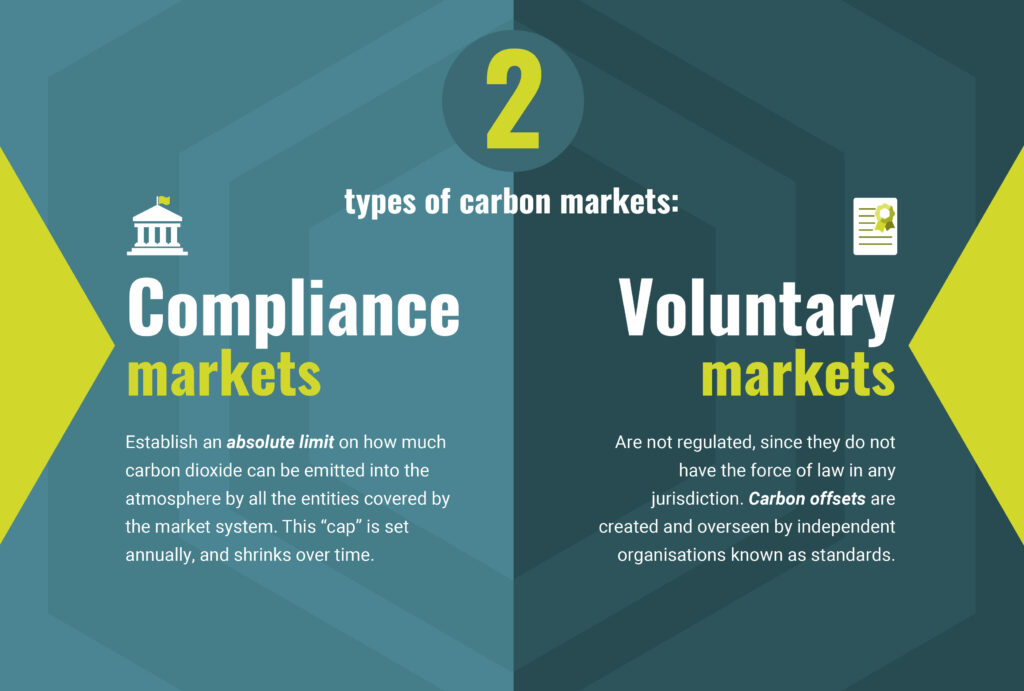
According to Investopedia, carbon markets are of two types: either compliance, also known as mandatory, markets or voluntary ones. Here is the difference.
Compliance, or mandatory, carbon markets are run by governments or multi-government bodies. These bodies control the supply and trading of credits. With around 30 compliance carbon markets today, they were valued for $850 billion in 2021. The global compliance carbon markets’ value is expected to grow 5% in 2023. Two of the major players here are the European Union’s Emissions Trading System (EU ETS), the People’s Republic of China.
Voluntary carbon markets, on the other hand, allow carbon credits to be traded voluntarily. They had a net value of around $2 billion in 2022. Major players here are the exchanges Xpansiv CBL in the U.S. and ACX in Singapore, and the United Nations Carbon Offset.
Carbon offset registries: challenges, and blockchain role
Carbon offsets’ logic is the following.
- An individual or a company plants a forest or aims to own an already existing one. An example here is what J.P. Morgan Campbell Global aquired of more than 250000 Acres of commercial Timberland in February 2023.
- This forest owner calculates the volume of CO2 that will be sequestrated by the forest’s area. The volume of CO2 calculated is equivalent to the credits to be sold to businesses producing CO2 emissions.
So, technically, the owner of the forest is selling the permission of polluting the environment by compensating for CO2 pollution by the CO2 that forests consume.
Carbon offset registries establish standardised protocols for project registration to issue carbon credits, maintain a comprehensive record of available credits in the market, and ensure that the environmental benefits tied to these credits are not double counted.
These registries play an important role in how carbon markets function. They are meant to track and verify emissions reduction or removal activities. The registries are databases recoding information about carbon offset projects, credits, and transactions. Example of the registries: the Berkeley Carbon Trading Project contains all carbon offset projects, credit issuances, and credit retirements listed globally by four offset project registries: American Carbon Registry (ACR), Climate Action Reserve (CAR), Gold Standard, and Verra (VCS).
Operating process
Registries typically operate through six phases:
- registration and documentation of a carbon offset project
- verification and monitoring
- issuance of carbon credits
- registry database
- trading and retirement
- market oversight
Challenges
Carbon registries face many challenges among which the rapid growth of the market, its volatility, the prices instability, carbon leakage, lack of stringency, distributional impacts, complexity and administrative costs, and international cooperation.
Blockchain and decentralisation
One of the tools to address these challenges is blockchain technology. This happens through the transparency and immutability, the enhanced traceability, smart contracts for automation, decentralisation and security, the tokenisation of credits, reduced administrative costs and international collaboration and interoperability.
For example, transparency in carbon registries requires trustworthy carbon credit data that is accurately monitored. The technology that blockchain offers promises a robust infrastructure. For example, Climate Action Data (CAD) Trust provides a harmonised and aggregated source of data.

Last words
Trading the act of polluting for a healthy environment is an intriguing and promising idea for a better ecological and environmental future. Does the person, or group, who came up with the carbon credit concept deserve a Nobel prize for peace or are they only greenwashing business as usual?
 data jungle adventures
Leave a comment