Imagine you have a parallel reflection of yourself, with all your physical details and traits, sitting on a server somewhere and undergoing all sorts of tests to see what look will fit you best if you want to, for instance, do a makeover. Creepy, no?
This may not be the case for you now, but it can certainly be the case for the line of trees providing shade for your house’s street. We can create its digital twin for multiple purposes. So what is a digital twin (d.t.)? And when it comes to trees, what can the digital twin (d.t.) be useful for?
d.t. definition
Digital twin, as defined by ibm.com, is a virtual model designed to accurately reflect a physical object. The Industrial Internet Consortium (IIC) defines a digital twin as follows:
“A digital twin is a formal digital representation of some asset, process or system that captures attributes and behaviors of that entity suitable for communication, storage, interpretation or processing within a certain context. The digital twin information includes, but is not limited to, combinations of the following categories: physics-based model and data, analytical models and data, time-series data and historians, transactional data, master data, visual models, and computations.”
Industrial Internet Consortium
The IIC says also that d.t. is used to simulate, predict, and optimize the performance of products, processes, and services.
Mmm! How can this be related to trees?
digital twin for trees
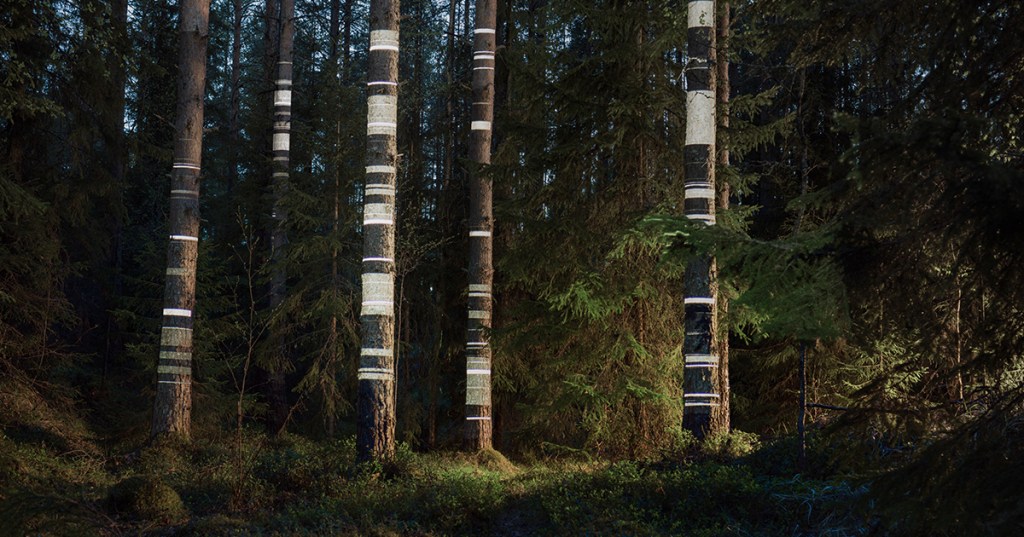
One of the emerging research topics, Understanding and managing trees in an urban context or any natural ecosystem is the main aim of the digital twin for trees. It helps monitor health and growth, predict maintenance, urban planning and design, disease and pest detection, educational and awareness purposes, research and conservation, and data-driven decision-making.
For this end, we need to create a functional digital twin of trees. This involves sensors, data collection devices, communication infrastructure, and software platforms. Here is an overview of some of the main components to consider digital twin for trees.
- Sensors are mainly for soil moisture, temperature, humidity, light intensity, air quality, tree movement during wind events. We need accurate data from these sensors. That’s why we need to consider strategically where these sensors are placed.
- A communication infrastructure is needed to properly transmit the data collected from the sensors to the central system managing the digital twin. The area’s connectivity options and data transfer requirements will dictate the technology needed here. It will include wireless technologies, cellular networks, or Low Power Wide Area Networks (LPWANs).
- The next step would be to aggregate, process, and store the collected data in a centralized system. You can base this system either on the cloud or on-premises.
- Analytics and visualisation software is essential to analyse the collected data and produce relevant visualisation output.
Apart from the aforementioned components, the installation of a digital twin project would take into consideration edge computing, power supply to sensors and communication processes, robust enclosures to protect elements of technology from vandalism, for instance, regulate maintenance, and integration with Geographic Information System (GIS) to visualise tree data on maps.
As much as this technology is useful and important, one of the main questions remains around the accessibility to it. It is not a cheap technology system to put in place.
For our next round on this subject, we will tour few cities where digital twin for trees is installed. Here are some hints: Singapore (Virtual Singapore), Barcelona (City OS), Amsterdam (Digital City Model), Dubai (Smart Dubai), London (London Infrastructure Map), New York (Building Energy Exchange), and Helsinki (3D City Model).
 data jungle adventures
Leave a comment