Taking a macro view on social-environmental challenges defined Biourbanism, as an applied research field that seeks to improve urban life.
It is “a nature centric city planning model that assists mayors, city leaders and planners create healthier, more resilient cities“. Biourbanism considers cities as a “form of nature” facing the Anthropocene epoch.
The major environmental concern on the global scale today is climate change. This model plays a role in mitigating the effects of climate change and revealing the nature side of cities. In his book, Biourbanism, cities as nature – a resilience model for anthromes, Adrian McGregor introduces biourbanism “as an urban planning and design model informed by data which acknowledges that cities function as complex ecological supra-systems, or anthromes” (p. 174).
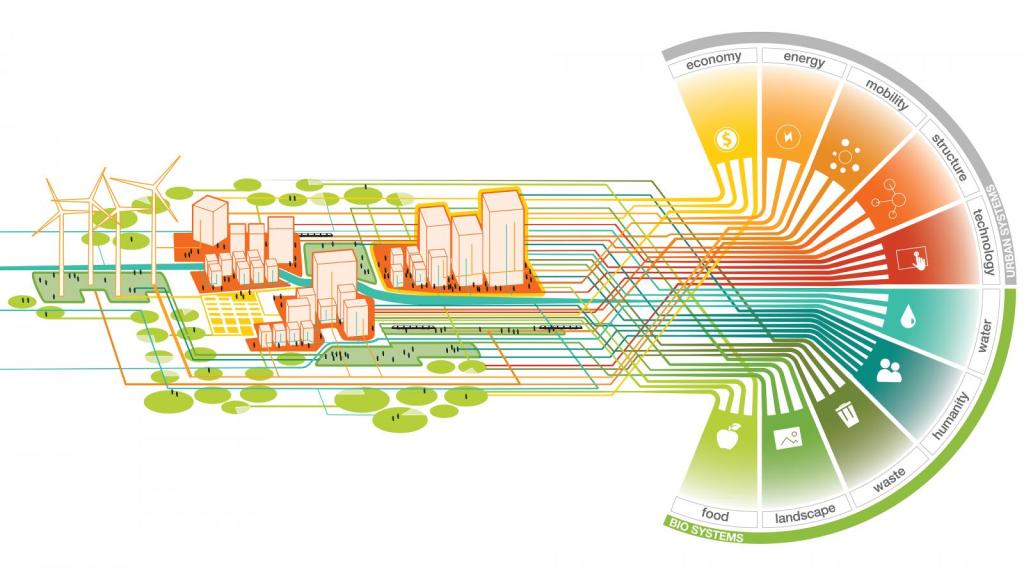
The biourbanism model aims to “determine the relative health and competitiveness of a region, city or project depending on the scale of investigation”. Ideally, the ultimate urban health is linked to purposefully managing interrelationships of systems in a way where: “intervention to an individual system does not trigger a significant detrimental impact on the other nine systems”.
McGregor divides the ten systems into five bio systems and five urban systems. In a first overview, we go through the resilience tactics of each of the five bio systems:
Citizens, Food, Landscape, Waste, and Water
For each system, a citation from McGregor’s book, the relevant components, and the related resilience tactics!
Citizens
“The primary purpose of a city is to provide a healthy, inspiring and productive habitat for its citizens.”
Adrian McGregor, 2022, p. 181
What components make up the resilience tactics for such a city’s citizens? McGregor determines six different areas of resilience tactics.
- In governance, through: providing fair access to public services, joining the global city mayors movement, setting anti corruption goals, striving for gender equality, preventing undue influence, harnessing design collaboration
- In health, through: care equality, enabling innovation clusters, averting mental crises, cleaning your air, tackling obesity, encouraging active job commuting, and mitigating extreme heat.
- Within education and employment, through: mandating children’s rights, making higher education affordable, growing your talent pool, creating green jobs, reskilling workers impacted by industrial automation
- In Law and safety, through: building trust in your laws, valuing police, being prepared for emergencies, listening to citizens, and enshrining public freedom.
- In Poverty and equality, through: ending poverty, promoting gender equality, and promoting cultural equality
- Within Design, culture and heritage, through: valuing design excellence, caring for heritage, valuing creative output, and nurturing culture.
Food
“…Humans living in urban populations rely upon an affordable local network of food supply chains connected to regional market distribution hubs…”.
Adrian McGregor, 2022, p. 191
Three areas build up the resilience tactics of the food system:
- Food security, through: growing urban agriculture, protecting fertile dirt, cleaning up food, preventing food gene contamination, reducing beef consumption, smart food, and go-organic.
- Decarbonisation, through: reducing food miles, inviting farmers, and storing soil carbon
- Community, through: building food sovereignty, improving urban diets, building food banks, and ending hunger.
landscape
“…Cities engineer wild and rural landscapes to suit their urban development needs through land development processes…”.
Adrian McGregor, 2022, p. 207
Which resilience tactics are related to landscape?
- Ecosystem health, through: repairing terrestrial biodiversity, preventing extinction, regenerating habit, conserving ecosystems.
- Public domain and streets, through: creating a high-performing public realm, unlocking lost public land, retrofitting roads into biostreets, deploying tactical urbanism, and reducing vehicle dominance.
- Green grid mapping, through: the existing open-space network, planning an open space framework (through: quality, quantity, access, and diversity), identifying open space needs, cooling the city, greening up grey infrastructure, digitising green data, and creating public space through private means
Waste
“Waste is the unwanted by-product of resource processing for human consumption. It requires disposal and decomposition…”.
Adrian McGregor, 2022, p. 223
How can waste relate to resilience tactics through three components?
- Emissions, through: waste collection, construction waste management, cut carbon emissions, capturing carbon, and measuring construction-embodied energy
- Pollution, through: clean air, water, and soil along with dark skies
- Solid waste, through: targeting zero waste, implementing a waste economy, reducing landfill, minimising waste incineration, and minimising hazardous waste
Water
“…Securing access to clean, unpolluted water is one of the greatest challenges facing humanity and has led to numerous city collapses in the past…”.
Adrian McGregor, 2022, p. 239
Resilience tactics related to water encompass:
- Ecosystem health, through: repairing aquatic biodiversity, preventing extinction, and regenerating habitat.
- Wastewater recycling, through: ban fracking to protect aquifers, mining sewer nutrients, modernising sanitisation, and fixing leaky pipes.
- Cloudburst design, through: designing blue grid plan, aiming for net zero external consumption, defending against sea level rise, decarbonising water infrastructure, mimicking natural drainage systems, restoring waterways and wetlands, maintaining clean
conclusion
The five bio systems of biourbanism bring together a group of resilience tactics to be deployed through 18 different components and their relevant elements.
Ideally, as stated earlier, intervention in one of these systems does not disrupt another system and does not trigger a detrimental impact on any of the other systems. For example, in the landscape system, creating a high-performing public realm should not interfere or disrupt the process of setting anti corruption goals which is part of the citizen system.
This does not apply only to the biological systems of Biourbanism, but also to the Urban systems.
Next, we will go through the Urban systems and their resilience tactics.
 data jungle adventures
Leave a comment