Open source licences are great for research, study, proof of concept, method developments and many other reasons. Which one did I omit? But not for commercial use. Obviously, some consultancy services can be sold without the data or results. Below is a list of my favourite tools, data catalogues and platforms I have encountered and used for fun, studies and research. This is obviously non-exhaustive.
Processing platform with data catalogue
Google Earth Engine
Google Earth Engine combines a multi-petabyte catalogue of satellite imagery and geospatial datasets with planetary-scale analysis capabilities.
- Time frame: various
- Spatial extent: global, US, various
- Service type: Catalogue and processing platform for environmental data
- https://earthengine.google.com/
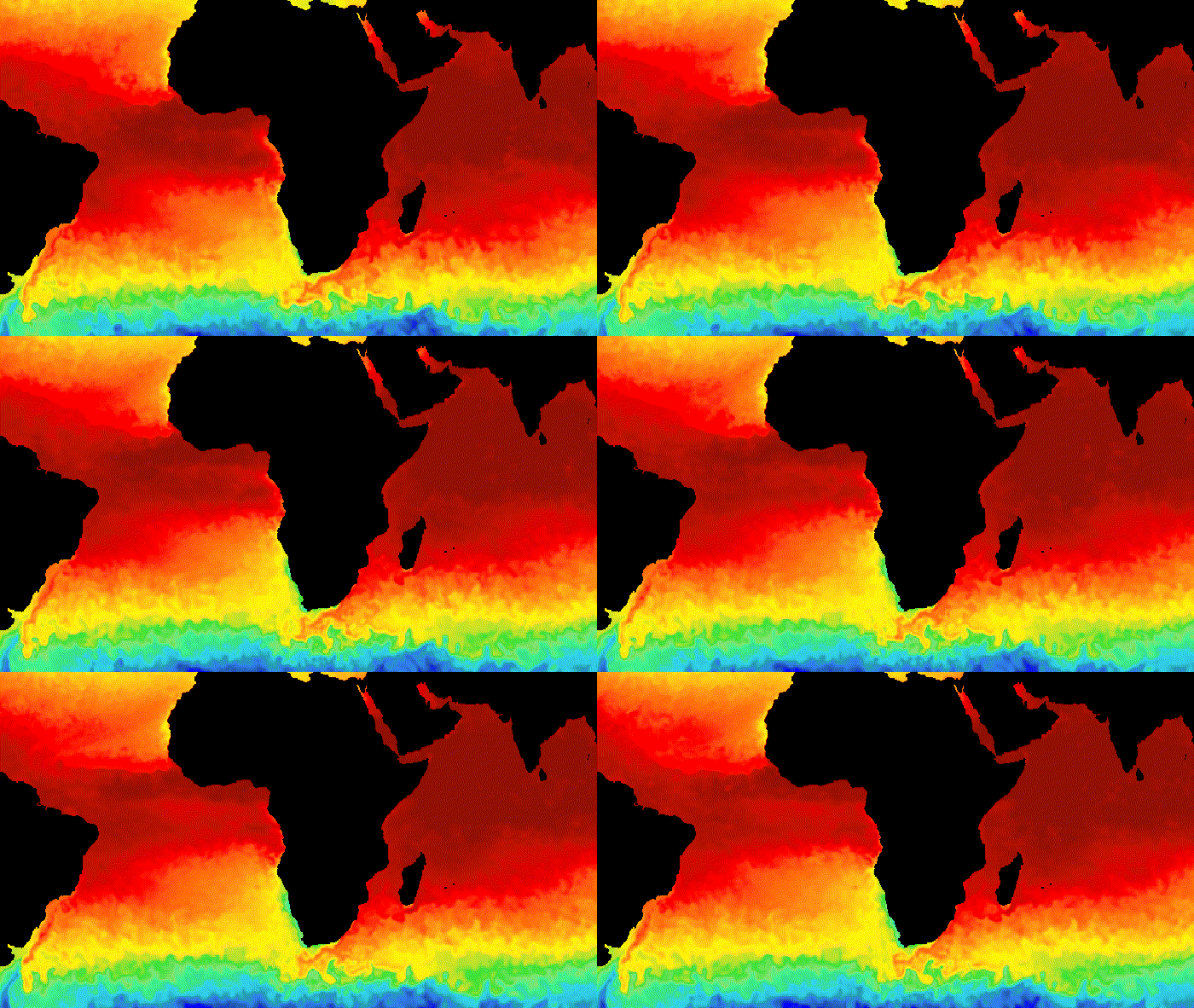
Excellent service to download, analyse, develop apps and tap into the cloud services via API.
Google Environmental Insights Explorer (Google EIE)
Google EIE uses data sources and modelling capabilities in a freely available platform to help cities measure emission sources, run analyses, and identify strategies to reduce emissions.
- Time frame: various
- Spatial extent: global, US, various
- Service type: Catalogue and processing platform for environmental data
- https://insights.sustainability.google/
Planetary Computer
The Planetary Computer Data Catalog includes petabytes of environmental monitoring data in consistent, analysis-ready formats. All of the datasets below can be accessed via Azure Blob Storage and used by developers whether you’re working within or outside our Planetary Computer Hub.
- Time frame: various
- Spatial extent: global
- Service type: Catalogue and processing platform for environmental data
- https://insights.sustainability.google/
Data platform/catalogue
Soilgrids
Soilgrids is a system for digital soil mapping based on a global compilation of soil profile data (WoSIS) and environmental layers. Read about the SoilGrids and WoSIS projects on isric.org.
- Time frame: various
- Spatial extent: global
- Service type: Catalogue for environmental data
Research level soil variables that are modelled globally. Reasonably easy to use through a batch download or R and python packages.
Global Biodiversity Information Facility
GBIF—the Global Biodiversity Information Facility—is an international network and data infrastructure funded by the world’s governments and aimed at providing anyone, anywhere, open access to data about all types of life on Earth.
GBIF provides the human and informatics infrastructure to enable primary biodiversity data to be made discoverable and accessible via the Internet. More than 1.8 billion species occurrence records, ranging from museum specimens to amateur observations, are accessible via the GBIF data portal. The data published through GBIF are used for various scientific applications, including modelling the potential spread of invasive alien species, projecting impacts of climate change on biodiversity and establishing priorities for collecting wild crop relatives.
- Time frame: various
- Spatial extent: global
- Service type: Catalogue for species occurrence data
- https://www.gbif.org/
Global data aggregator for all nation herbaria or other data collector, holders private or public. Easy to download through the website or R and python packages and API. Also, great science competitions for open data, analysis and collection specialists.
Worldclim Climate Data
WorldClim is a database of high spatial resolution global weather and climate data. These data can be used for mapping and spatial modelling.
- Time frame: Historical, historical monthly weather, future
- Spatial extent: global, 10-0.5 arc minutes resolution
- Service type: gridded climate data set
- https://www.worldclim.org/
CliMond Climate Data
The CliMond climate dataset consists of gridded historical climate data and some future climate scenario data at 10′ or 30′ spatial resolution. The underlying historical data is sourced from the Worldclim and the Climate Research Unit (CRU) (CL1.0 and CL2.0) datasets. These data were reformatted, adjusted and recombined to generate all the required variables, as detailed in Kriticos et al. (2012). The Worldclim dataset draws primarily on data between 1961-1990, though station records from 1950 to 2000 were used occasionally to fill gaps in documents. The CRU datasets draw exclusively on data from 1961-1990.
- Time frame: historical and some future climate scenarios
- Spatial extent: global, 10-30 arc seconds resolution
- Service type: Gridded climate data set
- https://www.climond.org/ClimateData.aspx
NCAR – climate data guide
The National Center for Atmospheric Research presents the Climate Data Guide funded by the National Science Foundation. This Guide provides reliable information on the strengths and limitations of the key observational data sets, tools, and methods used to evaluate Earth system models and to understand the climate system.
This is a platform to contribute. Experienced data users and developers write citable commentaries while enabling scientists to increase their work’s visibility and the diverse user community to access and understand data that underpin climate science.
This Guide brings together searchable observational datasets and climate indices. No data can be downloaded here, but you are invited to join the Network of Experts by commenting on data strengths and limitation to the Guide.
For example, experts did an overview and comparison table of precipitation data sets and categorised those onto:
- gauge data sets: Climatic Research Unit Timeseries (CRU TS), Global Precipitation Climatology Centre (GPCC), Asian Precipitation – Highly – Resolved Observational Data integration Towards Evaluation of Water Resources (APHRODITE)
- satellite-only data sets: High Resolution Precipitation Analysis: CHOMPS
- merged satellite-gauge products: CPC Merged Analysis of Precipitation (CMA), Tropical Rainfall Measuring Mission (TRMM)
Intergovernmental Panel on Climate Change data
The Task Group on Data Support for Climate Change Assessments aims to guide the IPCC’s Data Distribution Centre on the curation, traceability, stability, availability and transparency of data and scenarios related to the reports of the IPCC.
The CliMond climate dataset consists of gridded historical climate data and some future climate scenario data at 10′ or 30′ spatial resolution. The underlying historical data is sourced from the Worldclim and the Climate Research Unit (CRU) (CL1.0 and CL2.0) datasets. These data were reformatted, adjusted and recombined to generate all the required variables, as detailed in Kriticos et al. (2012). The Worldclim dataset draws primarily on data between 1961-1990, though station records from 1950 to 2000 were used occasionally to fill gaps in documents. The CRU datasets draw exclusively on data from 1961-1990.
- Time frame: future climate scenarios
- Spatial extent: global
- Service type: Climate data
- https://www.ipcc.ch/data/
Physical Sciences Laboratory
The NOAA Physical Sciences Laboratory (PSL) conducts weather, climate and hydrologic research to advance water availability and extremes prediction.
PSL archives data ranging from gridded climate datasets extending hundreds of years to real-time wind profiler data at a single location. The data or products derived from this data, organised by type, are available to scientists and the general public at the links below.
- Time frame: current
- Spatial extent: global
- Service type: data catalogue
- https://psl.noaa.gov/data/index.html
Open Street Map
Crowd sources, machine-reviewed vector data of the world, created by people like you and free to use under an open licence.
- Time frame: current
- Spatial extent: global
- Service type: vector data of all natural and man-made features
- https://www.openstreetmap.org/
Everyone knows this for mapping in standard GIS, but there are compelling editing and downloading tools that allow usage as base data in all projects.
United Nations Environmental Program
The UN shares part of its project data online. Documents, reports, GIS and other data types are public and partially interactive.
- Biodiversity lab: https://map.unbiodiversitylab.org/earth
- Air quality: https://www.iqair.com/unep
There is much more to discover, and the majority of info and data is available simply through a browser, without any download functions.
The project data is also mapped but too heterogeneous to be easily summarised. I will continue to explore and report back soon: https://open.unep.org/.
 data jungle adventures
Leave a comment